
I’m Dr. Sunil S. Raikar — a fetal medicine specialist, a husband, and, more recently, a father to a beautiful little girl.
I completed my MBBS at Bangalore Medical College, followed by my MD in Obstetrics and Gynaecology at AIIMS Jodhpur, and a fellowship in Fetal Medicine at Kasturba Medical College. Throughout my journey, from internship and residency to specialised training in fetal medicine, I have witnessed the many emotions that accompany pregnancy.
But amid the countless scans, consultations, questions, and concerns, I began noticing a pattern.
A pattern that stayed with me long after I left the hospital.
The men sitting outside the OPD
I would often see men sitting outside the outpatient departments and labour rooms.
They looked worried. Some were visibly anxious. Others sat quietly, waiting for their partners to come out of a consultation.
They were concerned about their wives, their unborn babies, and what lay ahead. Yet many seemed unsure about what was happening, what questions to ask, or how they could help.
They were present, but often unprepared.
As a doctor, I could explain the medical aspects of pregnancy. I could talk about fetal growth, ultrasound findings, investigations, and the next steps in care.
But I began to realise that the questions troubling these men did not always have medical answers.
How do I support my wife when she is anxious?
What should I do when her moods change and I don’t understand why?
How do I prepare myself for the responsibility of becoming a father?
Is it normal to feel scared?
And perhaps the most important question of all: Who do I talk to about what I’m going through?
I saw the uncertainty. I saw the concern. But I also saw how rarely these questions were discussed openly.
At the time, I understood only a part of the problem.
Then life gave me a different perspective.
When I became a father myself
Recently, my wife, Ankita, and I welcomed our beautiful daughter into our lives.
And suddenly, the subject I had spent years observing professionally became deeply personal.
I had medical knowledge. I understood pregnancy, fetal development, ultrasound scans, and the clinical aspects of childbirth. As a fetal medicine specialist, I knew how to assess many of the concerns surrounding an unborn baby.
But knowing the medicine did not mean I automatically knew how to navigate the experience.
Nobody had really sat me down during my journey and explained how to become a better husband during pregnancy. Nobody had given me a practical guide to becoming a father.
There were plenty of expectations, suggestions, and opinions. Much of the advice came wrapped in familiar cultural beliefs.
You are the man. You have to be strong.
You have to take care of your family.
You have to be responsible.
But very few people explained what these things actually meant in everyday life.
How do you support your partner when you are worried yourself?
How do you balance your professional responsibilities with the needs of a growing family?
How do you deal with financial uncertainty, changing priorities, and the feeling that your life is about to become very different?
And how do you acknowledge your fears when society expects you to be the person who has everything under control?
I began to realise that this was not simply a problem of insufficient knowledge.
It was also a problem of how we prepare men for fatherhood — or, more accurately, how little we prepare them.
We teach boys to be responsible. We tell men to provide and protect. But we rarely teach them how to communicate, how to offer emotional support, how to recognise their own vulnerabilities, or how to navigate the profound changes that pregnancy brings to a relationship.
We expect them to know what to do, often without ever showing them how.
The three worlds a man must learn to navigate
As I reflected on my clinical experiences and my own transition into fatherhood, I began to see three interconnected areas of concern.
1. The baby: The fear of the unknown
The health of the unborn baby is often the first concern that comes to mind.
Is the baby growing well? Are the scans normal? Is everything progressing as it should?
These concerns receive considerable attention, as they rightly should. Medical consultations, investigations, and fetal medicine help answer many of these questions.
Yet even here, there can be gaps in understanding. Medical information can be overwhelming, and not every expectant father knows how to interpret it, what to ask, or how to cope with uncertainty.
Understanding the pregnancy is the first step towards becoming an informed and involved father.
But it is only one part of the journey.
2. The partner: Understanding what she is going through
Pregnancy changes a woman’s body, routines, emotions, and often her relationship with the world around her.
There may be physical discomfort, mood changes, body-image concerns, career uncertainties, fears about childbirth, and worries about what motherhood will mean for her identity.
For the partner watching from the outside, these changes can sometimes be difficult to understand.
You may want to help but not know what to say. You may try to solve a problem when all she needs is someone to listen. You may misinterpret her discomfort or emotions simply because you do not fully understand what she is experiencing.
Good intentions are important, but they are not always enough.
Sometimes, what makes the difference is having the right perspective — understanding what your partner might be going through and learning how to support her without dismissing her feelings or assuming you already know what she needs.
You do not have to experience pregnancy in the same way she does to become a more empathetic partner.
You have to be willing to understand.
3. The man: The person everyone expects to be ready
This is the part we rarely talk about.
The man is also going through a major life transition. His partner is not the only one preparing for a new identity, new responsibilities, and a different future.
He may be thinking about finances, career progression, time management, professional ambitions, and the dreams he may need to reconsider.
He may wonder whether he will be a good father. Whether he will be able to provide enough. Whether he will know what to do when his child needs him.
He may feel excited and grateful, yet anxious about the changes ahead.
And sometimes, he may feel guilty about admitting any of this.
After all, isn’t he supposed to be the strong one?
The provider? The person who keeps everything together?
But being strong does not mean being free of fear. Being responsible does not mean having all the answers. And becoming a father does not mean your own emotional needs suddenly disappear.
A man can be deeply committed to his family and still feel overwhelmed by the transition. Both things can be true.
Recognising this is not a sign of weakness. It is an important step towards becoming a more present partner and a more thoughtful father.
The iceberg I had failed to see
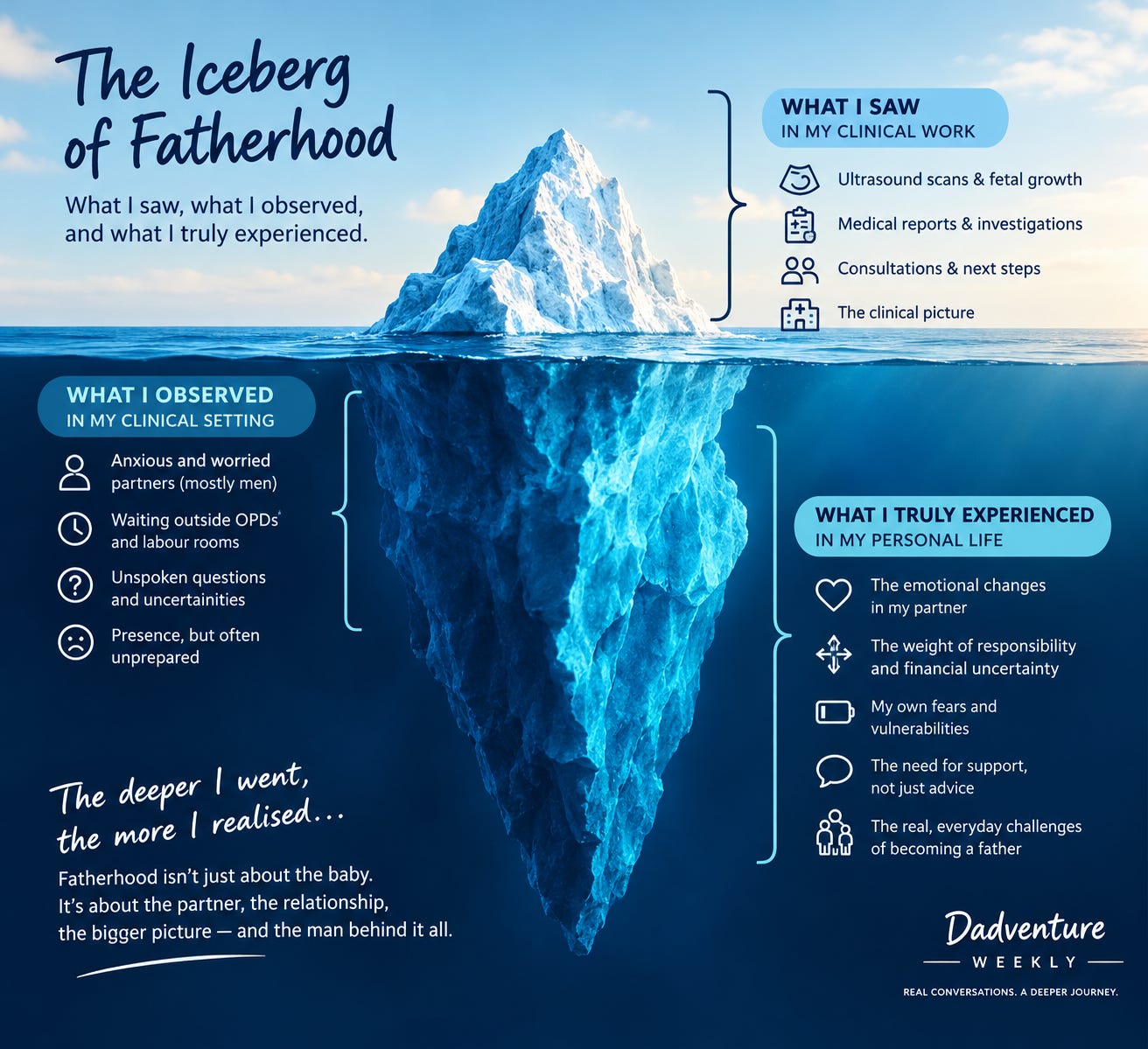
For years, my clinical work had shown me the visible part of the problem: anxious faces, unanswered questions, worried partners, and men who seemed unsure of their role.
After becoming a father myself, I began to understand how much lay beneath the surface.
I started thinking of it as an iceberg.
Above the water are the obvious questions about scans, childbirth, and the baby’s health. These are the concerns we can often see and address directly.
Beneath the water lie the less visible struggles: relationship dynamics, emotional uncertainty, financial pressures, changing identities, career concerns, cultural expectations, and the quiet fear of not being good enough.
The visible part is only the beginning.
And if we focus exclusively on what is visible, we risk overlooking the very things that shape a man’s experience of becoming a father.
This is not about suggesting that men and women experience pregnancy in the same way. They don’t. Nor is it about shifting attention away from the woman who is carrying the pregnancy.
It is about recognising that supporting a mother and preparing a father are not competing priorities.
They belong together.
A better-informed, more emotionally aware, and more involved father can be better equipped to support his partner and participate meaningfully in the journey.
And that is worth talking about.
Why I started Dadventure
Dadventure grew out of these observations — first as a question, then as an idea, and eventually as a commitment.
What if men had a place where they could find reliable information about pregnancy and fetal development, understand what their partners might be experiencing, and explore the emotional and practical realities of becoming a father?
What if we could talk about fatherhood without pretending that every man already knows how to do it?
What if we replaced rigid expectations with understanding, silence with conversation, and guesswork with practical guidance?
That is what I hope to build through Dadventure.
As a fetal medicine specialist, I want to make the medical aspects of pregnancy easier to understand. As a husband, I want to explore what it means to show up for your partner. And as a father who is learning along the way, I want to make room for the questions, doubts, and experiences that are often left unspoken.
I do not claim to have all the answers. Becoming a father is not an examination you pass once and for all. It is a continuous process of learning, adapting, making mistakes, and trying again.
My intention is to bring together medical knowledge, practical insights, and honest reflections to help men navigate this journey with greater clarity and confidence.
What you can expect from Dadventure Weekly
Through this newsletter, I plan to explore three broad themes:
-
Understanding the baby: Pregnancy, fetal development, ultrasound scans, and the medical questions that every expectant parent deserves to understand.
-
Understanding your partner: The physical, emotional, and practical changes of pregnancy, and how to become a more empathetic and supportive partner.
-
Understanding yourself: The transition to fatherhood, emotional well-being, relationships, finances, career pressures, identity, and the realities of balancing responsibility with personal aspirations.
Some articles will be educational. Others will be reflective and personal. Many will combine both.
My goal is to make each article useful — something you can learn from, reflect on, or perhaps share with a friend who is about to become a father.
I also want Dadventure to be a space where we can question the assumptions we have inherited about masculinity, marriage, and parenting, without judgement and without pretending that there is one perfect way to be a father.
An invitation to join me
If you are expecting a child, already a father, supporting a partner through pregnancy, or simply trying to understand what it means to become a better husband and parent, I hope you will find something valuable here.
And if you are someone who has ever sat outside a consultation room, worried about your partner or your baby, wondering what comes next, I want you to know that your questions matter, too.
You do not have to figure everything out on your own.
I have started Dadventure as a small effort to address a much larger, often overlooked part of the journey into parenthood. I will be sharing a new article every week through Dadventure Weekly on Substack.
For now, the newsletter is free. I want these resources to reach as many people as possible, because conversations about fatherhood should not be limited to those who already know where to look.
If this resonates with you, please subscribe to Dadventure Weekly so each new article arrives directly in your inbox. Share it with an expectant father, a new dad, or anyone who might benefit from these conversations.
We spend a great deal of time preparing for the arrival of a baby.
Perhaps it is time we also spent a little more time preparing the person who is becoming a father.
Welcome to Dadventure.
Let’s figure this out, one adventure at a time.
Help me make Dadventure Weekly more useful for you!
I’m planning to publish one article every week, and I’d love to know when you’d prefer to receive it in your inbox.