
When I started thinking about what a father could do to prepare himself for fatherhood, I realized something.
There wasn’t going to be one straightforward answer.
As an OB-GYN and fetal medicine specialist, I have spent years working with couples on their journey towards parenthood. I have seen pregnancy from the medical side, helped couples navigate challenges, and witnessed the many things that can happen along the way.
But the more I thought about a father’s role, the more I realised that knowing about pregnancy medically is only one part of the picture.
A father doesn’t necessarily need to become a doctor. He doesn’t need to know every complication that can occur during pregnancy. And he certainly doesn’t need to have everything figured out before the baby arrives.
But I do believe he needs to prepare.
And I began asking myself a simple question:
If a father-to-be wanted to start preparing today, what should he focus on first?
I kept coming back to three things.
Knowledge. Physical fitness. Support system.
That was the beginning of what I now call the Dad Readiness Score (DRS).
Why these three things?
1. Knowledge: Do I know what to do?
Let’s start with medical awareness.
I’m not suggesting that every father should learn to manage a pregnancy or treat medical problems. That’s not his job.
But there are certain things every father-to-be should know.
What are the warning signs during pregnancy that require immediate medical attention? When should he take his partner to the hospital? What needs to be packed before the delivery? What should he expect during childbirth and in the first few weeks after the baby arrives?
These aren’t questions that require a medical degree. They require awareness.
In a stressful situation, knowing when to seek help can make a real difference. Understanding the basics can also help a father support his partner without feeling completely lost.
And here’s something I find interesting.
Even though I’m an OB-GYN and a fetal medicine specialist, I wouldn’t give myself a perfect score in this category.
I’d probably score myself 8 out of 10.
Why?
Because medicine is vast. I know my field, but I also know when I need another expert’s opinion. I would still reach out to colleagues who specialise in a particular area.
If I don’t consider myself a 10, I don’t think the expectation should be that every father knows everything.
The goal isn’t perfection. It’s being informed enough to recognise situations, make sensible decisions, and know when to ask for help.
2. Physical fitness: Is my body ready?
This is something I think we often underestimate.
There are nights when sleep becomes a luxury. There are endless diaper changes, carrying, rocking, walking around the house, and trying to settle a crying baby. Sometimes, just getting through the day can feel like an achievement.
Fatherhood is not an athletic competition. You don’t need six-pack abs or a gym membership to be a good dad.
But you do need a reasonable level of stamina, mobility, and physical resilience to manage the demands of everyday baby care.
So I wanted to make this parameter less vague.
Instead of simply asking, Am I fit?, imagine this:
Can I comfortably carry a 10 kg load, representing a growing baby, for 30 minutes?
Not just lift it. Not carry it for two minutes and put it down. Can I manage it comfortably, without being completely exhausted or gasping for breath afterwards?
For the DRS, this is an illustrative benchmark to help you think about your physical readiness, not a scientifically validated fitness test.
The idea is simple: if you feel you need to improve your stamina, strength, or general health, this is your opportunity to start.
You don’t have to become an athlete before becoming a father.
You just need to start taking your health seriously.
3. Support system: Who will be there when we need help?
Of the three parameters, this is the one I personally find particularly important.
And perhaps the one we think about the least when preparing for a baby.
When we talk about a support system, we often imagine a joint family, grandparents living nearby, relatives dropping in, or friends who are always available.
But support isn’t just about how many people you know.
It’s about how many people you can actually rely on when you need them.
My wife and I have both sets of parents living away from us. That means we cannot automatically assume that someone will be available to help at home whenever we need them.
If I were scoring myself on the support system parameter, I would probably give myself 3 out of 10.
That doesn’t mean we have nobody. It means that the help we can reliably access is limited in certain situations.
And that’s an important distinction.
You may have loving parents, wonderful friends, and supportive relatives. But if everyone lives far away, has work commitments, or cannot help at short notice, your practical support system may still be limited.
Think about the different kinds of help you might need.
Someone to take you to the hospital in an emergency. Someone who can help with meals. Someone who can look after the baby while you catch up on sleep. Someone who can run an errand when both parents are exhausted. Someone you can call when you simply need emotional support.
You may not need all these things every day. But when you do need them, will someone be available?
And if the answer is no, what can you do about it now?
Perhaps you can identify a reliable neighbour, build friendships with other parents, arrange paid help, or have an honest conversation with your partner about how you will manage the first few weeks.
A support system doesn’t have to be a large family.
It has to be a dependable plan for getting help when you need it.
How I developed the Dad Readiness Score
Once I had identified these three areas, I wanted to turn the idea into something practical.
I didn’t want another long checklist that fathers would read once and forget.
I wanted something simple enough that a father-to-be could sit down, spend a few minutes reflecting on his life, and identify where he needed to improve.
That led me to create the Dad Readiness Score.
The scoring system is straightforward. There are three parameters, each scored out of 10.
-
Knowledge: How much do I know about pregnancy, childbirth, emergencies, and early baby care?
-
Physical fitness: How comfortably can I manage the physical demands of caring for my partner and baby?
-
Support system: How much reliable help can I arrange when I need it?
Add the three scores together.
Your total will be out of 30.
But I want to make one thing clear: this is a tool I have developed to encourage reflection and action. It has not yet undergone formal validation. The scoring benchmarks and categories are starting points, not established medical standards.
I hope that, with feedback and further study, the tool can be refined and evaluated more rigorously.
For now, its purpose is to help fathers start asking the right questions.
Let’s calculate your Dad Readiness Score
You don’t need to overthink this. Be honest with yourself.
Step 1: Score your knowledge out of 10
Imagine answering 10 basic questions about pregnancy, childbirth, warning signs, hospital preparation, and newborn care.
How many could you answer correctly and confidently?
If you can answer five, give yourself 5/10. If you can answer eight, give yourself 8/10.
You aren’t expected to know everything. The point is to understand where you stand today.
Step 2: Score your physical fitness out of 10
Think about the physical demands of caring for a baby.
Could you comfortably carry a 10 kg load for 30 minutes? Could you manage everyday baby-care tasks without becoming excessively exhausted?
Use the illustrative benchmark discussed above to reflect on your stamina. If you struggle, don’t treat it as a failure. Treat it as a starting point.
Step 3: Score your support system out of 10
Imagine 10 types of help you might need during pregnancy, delivery, and the first few months after birth.
How many could you reliably arrange?
Consider practical help, emotional support, transport, household responsibilities, and baby care.
Count the help you can genuinely access, not just the people in your contact list.
Step 4: Add your scores
For example, if your scores are:
-
Knowledge: 7/10
-
Physical fitness: 5/10
-
Support system: 3/10
Your total Dad Readiness Score is 15/30.
But don’t focus only on the total.
Two fathers could score 15/30 and have completely different needs. One might need to learn more about pregnancy, while the other might need to build a reliable support network.
Your lowest score is where you can begin.
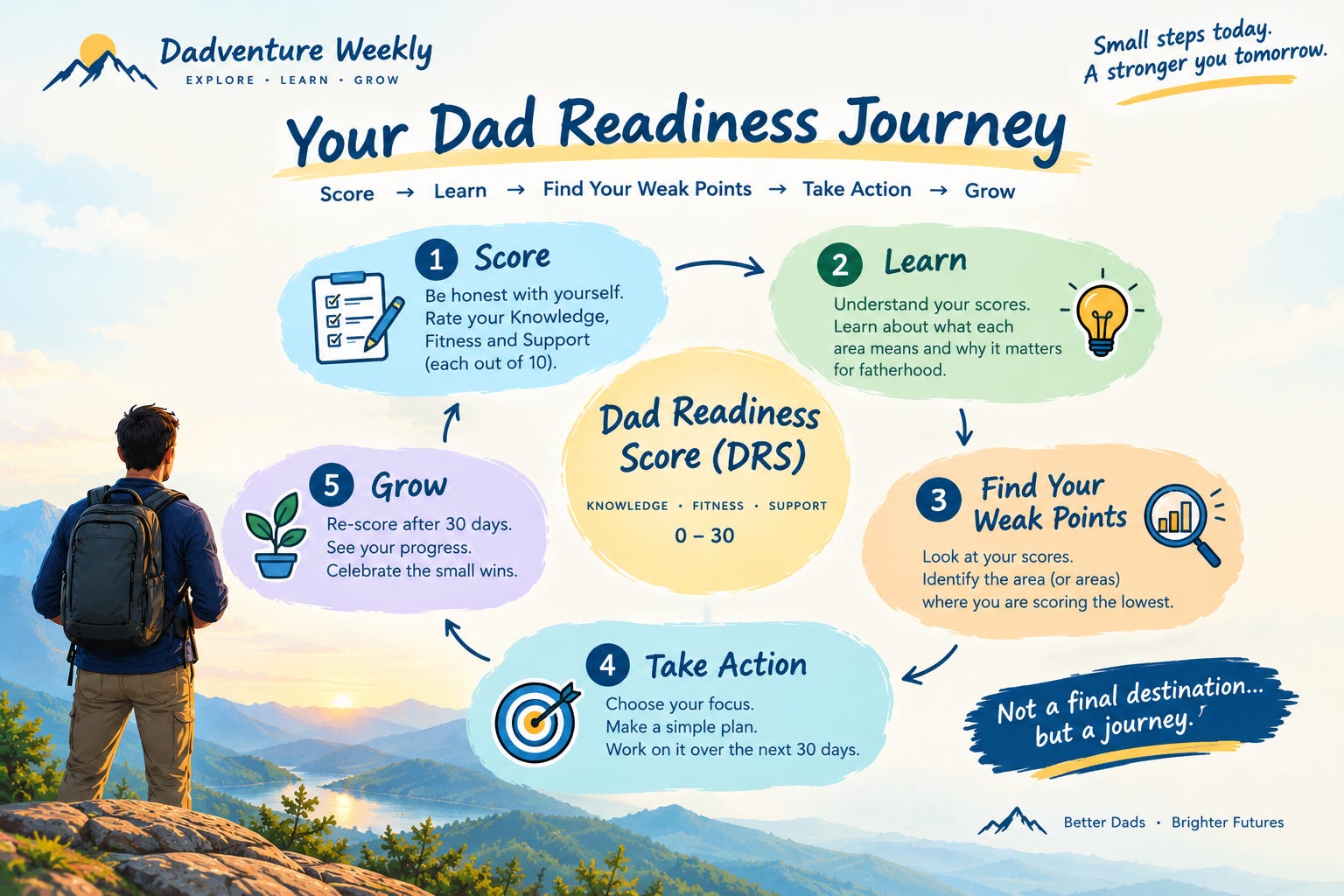
Your score isn’t a verdict. It’s a starting point.
I want the Dad Readiness Score to do more than give fathers a number.
I want it to start conversations.
If your knowledge score is low, start learning. Read reliable resources, speak to your doctor, and learn alongside your partner.
If your fitness score is low, start with manageable changes. Walk regularly, improve your sleep where possible, eat well, and address health concerns.
If your support score is low, talk to your partner. Identify the people you can call, the tasks you may need help with, and the arrangements you can make before the baby arrives.
You don’t have to fix everything overnight.
My suggestion is to choose the area where you need the most improvement, work on it over the next 30 days, and then score yourself again.
The aim isn’t to become a perfect father before your baby arrives.
It’s to become a more prepared one, one step at a time.
And I want to hear from you.
So, what’s your Dad Readiness Score?
I’m going to put up a poll alongside this article, and I’d love for you to participate.
Think about your knowledge, physical fitness, and support system. Give yourself a score out of 10 in each category, add them up, and select the corresponding range in the poll.
Don’t worry about getting a perfect score. This isn’t an examination, and there are no prizes for scoring 30.
I’m interested in understanding where fathers feel prepared and where they feel they need help.
Your response will also help me understand whether this framework resonates with other fathers and what we might need to improve in future versions of the DRS.
If you’re already a father, score yourself based on what you know and the support you have today. If you’re expecting your first child, score yourself based on where you stand right now.
And if you are planning to become a father someday, you’re welcome to take part too.
Because preparing for fatherhood shouldn’t begin only when the baby arrives.
It can begin today.
— Dr. Sunil S. Raikar
Founder, Dadventure
The Dad Readiness Score is a self-reflection tool developed by me. It is not a validated clinical assessment or a substitute for professional medical advice.
Ready for Fatherhood? Take the Dad Readiness Score!
Thinking about becoming a dad or preparing to welcome your little one? Take a few minutes to discover how prepared you feel across three key areas: Knowledge, Physical Fitness, and Support System.
📩 Complete the Dad Readiness Score (DRS) and receive your personal score by email. Use it as a starting point to reflect, grow, and prepare for the journey of fatherhood.
👉 Take the Dad Readiness score here
You don’t have to be a perfect dad-to-be. You just have to be willing to prepare.